Bet you weren't expecting this to appear on Gathering of Hosts:
A few years ago this vignette was one of several RAFM sets that I couldn't resist as long as I was ordering... something or other. Now they are painted.
Haven't decided yet if they should be gloss varnished and added to the People of the Forests host or not.
Showing posts with label RAFM. Show all posts
Sunday, June 17, 2018
Saturday, April 11, 2015
Couldn't help myself
All I really wanted was a bit of modelling putty and the first place this side of the border that has any was RAFM. Seemed a shame to pay all that postage for just one thing.
She'll find a home in the West Folk Host, probably leader of one of the bands of forest critters and woodsmen despite her Desert Warrior listing. My Historical Ancients credentials have just slipped another notch but I'm enjoying myself.
Usual light grey prime and cheap craft acrylics.
Still haven't got the putty, hopefully its back ordered. In the meantime, "Something wicked this way comes"........
![]() |
| RAFM 25mm Character RAF03922 |
Usual light grey prime and cheap craft acrylics.
Still haven't got the putty, hopefully its back ordered. In the meantime, "Something wicked this way comes"........
Wednesday, February 20, 2013
Pass in Review
Since my decision to drop first Warhammer Ancient Battles and then the Mede-Lydian campaign, my poor battered collection of ancients has again been tossed on stormy seas. I have a plan in mind but it doesn't exactly have places for all of the existing figures. So I am left again to sort through seeing what should be saved, what should be scrapped or re-homed. The goal as always is that the available display area must not be exceeded and that figures should get to be played with often enough to be worth keeping.
I had been starting to think about making room by disbanding and disbursing my Greek and Persian troops since they don't fit into current plans and if all are fixed up, there are too many for my current table space. Unfortunately I hauled them out for a game last week and it occurred to me that I've finally painted up enough to play a game and with just a little work I can put aside a Greek & Persian Wars "game in a box". Questions remain. How big a box? Who gets to be re-based? Who has to go?
For now the remaining hoplites can serve on their 20mm frontage per figure bases but I intend to cram them back into 8 figures per 60mm wide element, 12 such elements to make the core of a Greek alliance army supported by some skirmishers and cavalry. The Persians will stay on the looser frontage but 3 deep for 9 figure elements. Perhaps 20 all told. That leaves a few stray Greeks, especially lighter troops, not to mention that I really should add some Spartans which would mean bumping yet more existing Hoplites. Some of the excess Persians are easily co-opted into the later 5 Kingdoms fictional setting but others, I'm just not sure about. Then there are some stray Italians left over from a foray into Carthage and there is the small band of Hellenistic pikes and peltasts who were to form part of the 5 Kingdoms but who just look too Hellenistic.
So, nothing decided but here are some of the troops whose fate is being pondered.
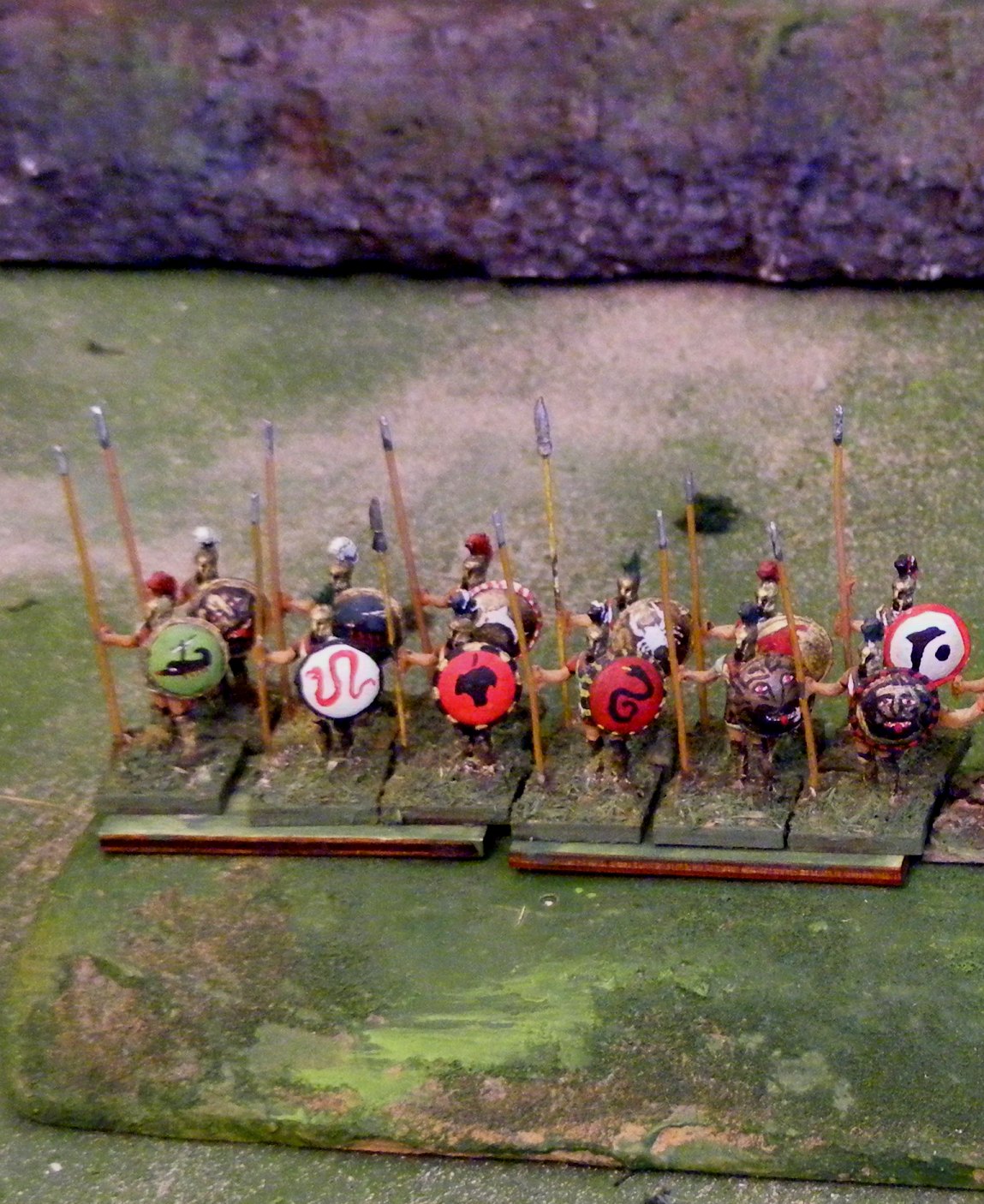
The miscellaneous Hoplite regiment composed of largely RAFM & Ral Partha figures and including a number of later hoplites, a mix of figures I like and others that I don't really..


Thracians from Rospak, Ral Partha, RAFM and Corvus. One can always find a place for a few Thracian mercenaries. the question is how many and do I want/need a whole Thracian army as opposed to one unit of mercenaries. There's another score or more that need some sort of repair or just aren't based at the moment as well as archers, slingers and cavalry.
______________________________________________________________________________
I had been starting to think about making room by disbanding and disbursing my Greek and Persian troops since they don't fit into current plans and if all are fixed up, there are too many for my current table space. Unfortunately I hauled them out for a game last week and it occurred to me that I've finally painted up enough to play a game and with just a little work I can put aside a Greek & Persian Wars "game in a box". Questions remain. How big a box? Who gets to be re-based? Who has to go?
For now the remaining hoplites can serve on their 20mm frontage per figure bases but I intend to cram them back into 8 figures per 60mm wide element, 12 such elements to make the core of a Greek alliance army supported by some skirmishers and cavalry. The Persians will stay on the looser frontage but 3 deep for 9 figure elements. Perhaps 20 all told. That leaves a few stray Greeks, especially lighter troops, not to mention that I really should add some Spartans which would mean bumping yet more existing Hoplites. Some of the excess Persians are easily co-opted into the later 5 Kingdoms fictional setting but others, I'm just not sure about. Then there are some stray Italians left over from a foray into Carthage and there is the small band of Hellenistic pikes and peltasts who were to form part of the 5 Kingdoms but who just look too Hellenistic.
So, nothing decided but here are some of the troops whose fate is being pondered.
The miscellaneous Hoplite regiment composed of largely RAFM & Ral Partha figures and including a number of later hoplites, a mix of figures I like and others that I don't really..
Rospak Hoplites, in service since 1982. Veterans but getting a bit tired, they drop their shields and spears a lot.
More Rospaks, also veterans, these never got new spears, they still have the 6 foot long ones, about 1/2 of which are broken as happened in real life apparently but distressing when you start a battle that way.
___________________________________________________________________
A "new" unit, only 4 years old. RAFM Seleucid Arab levies recruited into my Persian army. Nothing wrong with them, I actually quite like them but which levies to keep? and is there a plausible place for them in the 5 Kingdoms where almost everyone else has pants and a tunic?
Another new unit, Rose Prestige Ethipeons. Lovely figures and nothing says Persian levy like Ethiopeans with fire hardened sticks, so maybe.
______________________________________________________________________________
RAFM multi-part Thureophorai. Too late for Graeco-Persian Wars so how Hellenistic do I want my forgotten outpost city? Or, do I want to add a few more Garrison S&S figures instead......?
RAFM & Ral Partha pikes. I'm really not big on pike phalanxes, I just happened to have had them from an abandoned earlier project.
___________________________________________________________________________
and the real strays, cobbled together Italians and some late Greek cavalry.
Sunday, April 24, 2011
Sorting the Subjects - Thracians
When I hauled my Thracians put last week, I was reminded that the units were looking a little battered. This seemed as good a time as any to sort them.
First order of business was to remove the figures from their various basing systems. About 1/2 were on 60mm x 60mm 6 man elements, 1/4 individually based on 20mm x 20mm bases and the rest on old WRG 3rd-6th ed bases with a mix of 1, 2 or 3 figures per base, 20mm wide per figure but 30mm deep.
Once that was done, I stripped out figures with helmets or thureos. That left me with about 72 figures. Subtracting broken figures brought that down to about 60. I considered a unit of javelin armed skirmishers but the need there is for Greeks not Thracians. Since these are RAFM multi-part figures, I decided to haul out the most suitable figures and re-head them with bare heads or petasos. That left me with 2 24 man units. For the last 25 or so years, my Rospak Thracians have been mixed in with my Ral Partha, RAFM and Corvus figures. I decided that it was time to separate them into two distinct units, 24 figures each. The remaining 24 figures, including a number of broken spear Rospak plastics, have been put aside as spare parts.
Rospak hard plastic Thracians.
While I was at in, I sorted out and based up 2 4 man stands of archers and 1 of slingers. The rest, mostly RAFM multi-part figures have gone into the spares box.
Various RAFM figures with Thracian caps.
Thursday, January 6, 2011
The Lydian Lancers begin to gather
Having made progress on the Phrygian infantry component of my Lydian army, I decided to start in on the cavalry. As always, the information is sparse and largely speculative. Its very possible that the Lydian cavalry looked a lot like some of the armoured lancers on contemporary Greek vases in chiton, bell corselet and plumed helmet or they may have looked more like the Amazon cavalry and like the infantry figures that were the inspiration for the Phrygian infantry that appear in the Funcken & Saxetorph books and the Garrison Miniatures ranges.. .
Going the Greek route would be fairly safe and possibly make the figures more widely usable. However, I already have more Greek cavalry than I can normally use and I want this project to feel semi-mythical so the less common (and less Greek) the better. I made two decisions:
1) The clothes should match my Phrygian infantry in style to promote a sense of identity in the army and of "not being in Kansas" so to speak.
2) Since the Lydians had close contact (and conflict) with various kingdoms which used iron lamellar or scale armour, it seemed reasonable that they may have used it and doing so would make them look less classic Greek even with Greek helmets.
I already had a few RAFM cavalry in scale armour so, last year during their big sale, I raided the various RAFM ranges for Hellenistic cavalry in scale armour and used Thracian and other helmets (including a cataphract helmet with full face plate just for the heck of it, looks very Hollywood) and gave them nice heavy spears.
It was tempting to get back into shading on these but after doing the stripes on the sleeves and other finnicky bits my enthusiasm sank back to normal and the gloss varnish confuses shading anyway (and the lens as well!).
As planned, there will be two new units of Lydian lancers each 12 strong plus two units raised from existing Greek & Macedonian heavy cavalry, (subjects, allies or mercenaries perhaps) and various light cavalry.
.
Thursday, August 26, 2010
Preparing for Platea - A Puzzling Question
The rules have been updated and are now available here: (Aug 27 post game)
The Athenians (Benassi) as seen from behind the Phrygian (Garrison) and Theban position. (The poor Thebans were left with the stragglers when I ran short on hoplites. At some point I need to finish refurbishing the last 48 RAFM hoplite types)
As I look at the table laid out for the refight, a puzzling question comes to mind:
Why didn't the Persians outflank and surround the Greeks?
The flanks don't appear to be resting on terrain, there are huge gaps in the middle of the line and lots of cavalry to ride around. The Thessalian cavalry seems to have given a deal of trouble to the Corinthinians and others marching up from the rear so were presumably ordered to ride past them but surely some of the cavalry could have been spared to attack the Athenians and/or Spartans from the rear?
Now I can see in the Dover refight that the lads were probably "in the spirit" and might not have considered such a move to be "on" but what about in the day? There are 3 possible answers that occur to me:
a) Heavily armed hoplites are dangerous to light troops and cavalry even if attacked in rear
b) There were command and control issues at work
c) Some of the Greek light armed troops who appear in the OB but not the battle narrative or the Grant scenario, were employed on rear security.
d) In the Grant scenario, Artabazos's troops start the game with the rest of the army rather than only coming up after the battle was essentially lost. That might substantially affect things.
Well, for the 1st run through, I am going to follow the battle plans in Grant's book as closely as possible so it shouldn't be an issue. I may try alternate versions later.
The Athenians (Benassi) as seen from behind the Phrygian (Garrison) and Theban position. (The poor Thebans were left with the stragglers when I ran short on hoplites. At some point I need to finish refurbishing the last 48 RAFM hoplite types)
As I look at the table laid out for the refight, a puzzling question comes to mind:
The Pseudo-Spartans (mixed RAFM, Ral Partha, Garrison & Minifig)
from behind the (largely Garrison) Persian center.
Why didn't the Persians outflank and surround the Greeks?
The flanks don't appear to be resting on terrain, there are huge gaps in the middle of the line and lots of cavalry to ride around. The Thessalian cavalry seems to have given a deal of trouble to the Corinthinians and others marching up from the rear so were presumably ordered to ride past them but surely some of the cavalry could have been spared to attack the Athenians and/or Spartans from the rear?
Now I can see in the Dover refight that the lads were probably "in the spirit" and might not have considered such a move to be "on" but what about in the day? There are 3 possible answers that occur to me:
a) Heavily armed hoplites are dangerous to light troops and cavalry even if attacked in rear
b) There were command and control issues at work
c) Some of the Greek light armed troops who appear in the OB but not the battle narrative or the Grant scenario, were employed on rear security.
d) In the Grant scenario, Artabazos's troops start the game with the rest of the army rather than only coming up after the battle was essentially lost. That might substantially affect things.
Well, for the 1st run through, I am going to follow the battle plans in Grant's book as closely as possible so it shouldn't be an issue. I may try alternate versions later.
The Corinthians in position at the foot of the mountain, a lonnnng way from the action.
Rospak hoplites obviously painted while my 1st canine buddy, Yoda the Black Lab was still alive and providing inspiration.
Please click on the pictures to see the full thing if you are only catching the corner.
Sunday, June 27, 2010
Missing Post
The following post was supposed to go up 3 weeks ago but I think I waited for pictures and then forgot it!
Belatedly:
The first infantry regiment has now been through the refurbishing mill. Originally I was just going to rebase the infantry but when dealing with individual figures, its a big help if you can easily identify which regiment stray figures came from. I don't buy suggestions that units were issued particular patterns of intricately embroidered clothing even if some items were handed down from above but I do want each regiment to have its own character as well as making it easy to identify which unit a figure comes from.
For the initial campaign, there will be 4 units of spara-bara, line infantry if you will. These are:
The Hyrkanian Regiment. (formerly fielded as Immortals, I have taken their rout in the last game as an excuse to down grade them and will order 'proper' Immortals in long robes to replace them) Yellow caps, red tunics, garrison miniatures carrying bow, spear and shield. This regiment has an associated cavalry regiment with similar dress and weaponry.
The Ecbatana Garrison Regiment. A regiment of Medes in white domed felt hats. Again, all garrison figures, 6 archers, 6 spear and spara (hats slightly modified), 12 bow, spear and shield.
The Raffum Regiment. A regiment of Iranians with white tiara, 12 archers, 12 spearmen. All RAFM figures.
The Scaran Regiment. A regiment of saka in coloured scythian caps, a mix of Garrison and Bennasi figures, all archers but the front rank will have spara (hats slightly modified and spears replaced).
Other planned regiments are the Susa Regiment of Elamite infantry in long robes and fillet, an as yet unnamed regiment of Mede spearmen, another Saka regiment which may be spara bara or light infantry and a regiment of guards in long robes..
The first infantry regiment has now been through the refurbishing mill. Originally I was just going to rebase the infantry but when dealing with individual figures, its a big help if you can easily identify which regiment stray figures came from. I don't buy suggestions that units were issued particular patterns of intricately embroidered clothing even if some items were handed down from above but I do want each regiment to have its own character as well as making it easy to identify which unit a figure comes from.
For the initial campaign, there will be 4 units of spara-bara, line infantry if you will. These are:
The Hyrkanian Regiment. (formerly fielded as Immortals, I have taken their rout in the last game as an excuse to down grade them and will order 'proper' Immortals in long robes to replace them) Yellow caps, red tunics, garrison miniatures carrying bow, spear and shield. This regiment has an associated cavalry regiment with similar dress and weaponry.
The Ecbatana Garrison Regiment. A regiment of Medes in white domed felt hats. Again, all garrison figures, 6 archers, 6 spear and spara (hats slightly modified), 12 bow, spear and shield.
The Raffum Regiment. A regiment of Iranians with white tiara, 12 archers, 12 spearmen. All RAFM figures.
The Scaran Regiment. A regiment of saka in coloured scythian caps, a mix of Garrison and Bennasi figures, all archers but the front rank will have spara (hats slightly modified and spears replaced).
Other planned regiments are the Susa Regiment of Elamite infantry in long robes and fillet, an as yet unnamed regiment of Mede spearmen, another Saka regiment which may be spara bara or light infantry and a regiment of guards in long robes..
Labels:
Garrison,
organization,
persian army,
RAFM
Saturday, June 19, 2010
The Lydian infantry musters
At last the dust is starting to settle and I have resumed painting, including the last of the Garrison Phyrgians. Here is the Sardis Regiment in all its splendour. That thicket of spears just cries out for another on each side but they will have to content with existing hoplite allies for now.
The Persian/Mede reorganization is also done leaving me with the Ecbatana Regiment of Garrison Medes:
and the Persians, the Raphum Regiment using RAFM miniatures:
The armies are not up to their full campaign strength yet but I am ready to begin and no substitutions will be allowed. Any missing units can be added as figures are painted.
The Persian/Mede reorganization is also done leaving me with the Ecbatana Regiment of Garrison Medes:
and the Persians, the Raphum Regiment using RAFM miniatures:
The armies are not up to their full campaign strength yet but I am ready to begin and no substitutions will be allowed. Any missing units can be added as figures are painted.
Labels:
25mm ancients,
Garrison,
lydian army,
persian army,
Phrygians,
RAFM
Friday, May 7, 2010
Shields up
The Raffum Cavalry Regiment
The first full regiment of Mede cavalry has now been refurbished, reorganized and rebased. If memory serves, they were originally raised in the mid-80's as three 10 man units for WRG 6th ed (2 heavy, 1 light) and have since fought under WRG 7th, Hoplite, DBA, Armati and WHAB. Most of the figures are converted RAFM Hellenistic cavalry but there are a few converted Ral Partha Scythians and a new Garrison standard bearer. Roughly half wear visible armour, the rest might have armour under their tunics, or not. The new individual bases have been lightly coated in sawdust to soften the edges of the figures' bases and then painted to match my tabletop. This treatment helps the troops to blend into their surroundings.
Their original equipment did not include shields. The use of shields use by Mede cavalry is moot and possibly the figures look better without them but it was late, the new standard bearer had a round shield and there was this pile of painted shields recently removed from a unit of slingers and they will come in useful against some of the enemies that I might ask them to fight. The shields I have used are probably not the most likely shape and design, rather they were what I had available.
There are two main reasons for wargame cavalry to carry shields, the first is that the historical troops definitely carried them, the second is that the troops might have used them and the chosen rules reward their use. A Persian wargame army using WHAB falls under the later category, especially if it might be used as a stand-in for later armies. Since WHAB is old fashioned enough to give saving throws based on how much armour a unit is carrying, more is better as long as it isn't heavy enough to slow the unit down. The points assigned can be skewed though. A shield or a light armour will double the save chances for a cavlryman but a shield is only 1/2 the price of the armour. This of of course encourages players to choose Persian cavalry with shield and no armour rather than the more probable armour and no shield. Having both is better yet. Now this is all pretty much irrelevant for my solo mini-campaign since I won't be counting points anyway but it bugs me none the less.
Did the Medes carry shields? Without getting too tedious, the evidence both written and pictorial would seem to indicate that at least some did at least some of the time. Why would they choose to use or not use shields in real life? The answer may be that a light shield is most useful to a horsemen engaged in hand to hand combat with other cavalry and to defend himself and his mount against missile fire but is an encumbrance to the bridal arm and makes control of the mount more difficult. When facing a Greek army, the opposing missile fire would not be a major issue and a shield would be insufficient protection to allow a frontal charge on a phalanx and wouldn't be needed if they were pursuing a broken one or attacking the flank or rear. When fighting an enemy with shock cavalry or one who relied on massed missile fire, a shield might have been more useful. The main armies that my Medes expect to face are: Lydians, Assyrians, Egyptians, fictional Alexandrian Successor, Romans and "barbarians". In all these cases, the shields will be useful if questionable.
Reviewing how my Mede cavalry works under the rules, I became aware of a problem. They don't have the oomph to be shock cavalry but if they ride up to opposing infantry to throw their javelins, they will be unable to avoid being charged except by fleeing with the possibility of causing panics and of never rallying. I have decided to deal with this in 2 ways. I intend to grant them the Parthian shot special rule which will allow them to ride up to infantry, shoot, then pull back out of charge reach. Against cavalry, they will still have to brace for impact or flee. Secondly, I have taken the step of deploying them as 6 man squadrons. These will be little threat by themselves and can be driven off by enemy missile fire but they will be very maneuverable (deployed 3 wide and 2 deep they will be able to "fast march" 24 inches per turn if they don't shoot and aren't embroiled with the enemy) and with several used together or if they can penetrate gaps in the enemy to hit his flank or rear, they are a force to be reckoned with. On the other hand, if routed, they will be too small to bother my main combat units. The rules make standards useful, but only 1 per combat is needed so I have decided to stay with 1 for each 2 units. This will allow me to field 4x 6 man units or 2x 12 man units.
So, without further ado we have:
Tuesday, April 27, 2010
Starting at Shadows
I should never have read all the way through Shadows in the Desert, at least not until I had finished my Medes and Lydians. My mind keeps wandering to my waiting Sassinind Clibinari & levy molds and Hinchliffe elephant kits and campaigning in even more remote and romantic lands in the back of beyond.
As an example of bad timing, RAFM is having a 40% off sales on ancients (see link to left) so while I ordered another pack of arab archers to bring my new unit up to 24, and enough Hellenistic cavalry to make the 1st Lydian cavalry regiment, there are also a dozen cataphracts and a mix of Scythian and Sarmatians coming to make a unit of 1/2 armoured Saka nobles. (cleverly able to do double duty). I resisted the temptation to add other things I wouldn't mind having and instead spent the rest of my unhatched eggs on some definitely early troops, some Rose Nubians to mix into my Ethiopeans to bring them up to 24, a regiment of Garrison 25mm Persians in long robes, not the guard yet, just some Persian tribesmen to fight for the Medes, oh and a dozen Garrison clibinari. Oh dear.
Well, never mind, I have only finishing touches and the first 16 Phrygian spearmen will be ready to take the field with the remaining 8 to follow soon. Rebasing and reorganization of the Medes has also begun. Including recycled Valdurian Royal Guards and various barbarians from the north, but excluding new recruits not yet recieved or cast, I have laid out 10 cavalry regiments in various states of disarray from almost table ready to debating stripping and repainting. 2 of these will be on 1/2 armoured horses, possibly a little pre-mature, 4 will be light and 4 medium/heavy. The OB calls for 6 units at the moment but I'm not sure if I can pawn off any on the Lydians as barbarian mercenaries. Only a few of the regiments are amenable to amalgamation into 18 or 24 man units but perhaps I will go back to the idea of fielding two 12 man squadrons as a scenario "unit" once they are all complete.
The question is, can I complete enough troops to make it proper to start a mini-campaign within 3 weeks?
As an example of bad timing, RAFM is having a 40% off sales on ancients (see link to left) so while I ordered another pack of arab archers to bring my new unit up to 24, and enough Hellenistic cavalry to make the 1st Lydian cavalry regiment, there are also a dozen cataphracts and a mix of Scythian and Sarmatians coming to make a unit of 1/2 armoured Saka nobles. (cleverly able to do double duty). I resisted the temptation to add other things I wouldn't mind having and instead spent the rest of my unhatched eggs on some definitely early troops, some Rose Nubians to mix into my Ethiopeans to bring them up to 24, a regiment of Garrison 25mm Persians in long robes, not the guard yet, just some Persian tribesmen to fight for the Medes, oh and a dozen Garrison clibinari. Oh dear.
Well, never mind, I have only finishing touches and the first 16 Phrygian spearmen will be ready to take the field with the remaining 8 to follow soon. Rebasing and reorganization of the Medes has also begun. Including recycled Valdurian Royal Guards and various barbarians from the north, but excluding new recruits not yet recieved or cast, I have laid out 10 cavalry regiments in various states of disarray from almost table ready to debating stripping and repainting. 2 of these will be on 1/2 armoured horses, possibly a little pre-mature, 4 will be light and 4 medium/heavy. The OB calls for 6 units at the moment but I'm not sure if I can pawn off any on the Lydians as barbarian mercenaries. Only a few of the regiments are amenable to amalgamation into 18 or 24 man units but perhaps I will go back to the idea of fielding two 12 man squadrons as a scenario "unit" once they are all complete.
The question is, can I complete enough troops to make it proper to start a mini-campaign within 3 weeks?
Labels:
25mm ancients,
Garrison,
Phrygians,
RAFM,
Rose
Monday, January 4, 2010
Tales from beyond the frontier
Last March, 4 of us got together for a weekend WAB campaign of the use what you got sort. My Persians, Gary's Assyrians, Big Jeff's Barbarian's and Little Jeff with his dad's Carthaginians. We played four 1 on 1 games (2 each) and then the Persians with their Assyrian levies, err I mean allies against the various outlandish types. Having seen what was out there, we decided there was no need to expand the Empire. (unhuh, yup that was our story).
In the first game, Rosius destroys the Phoenician Rebels, err I mean the Carthaginians, despite their use of strange beasts.
Persian levies massed for the final battle. Pity that our Assyrian allies cracked...........
RAFM Skythian noble cavalry chases off some some barbarian tribesmen.
Labels:
25mm ancients,
persian army,
RAFM,
wab
Saturday, November 14, 2009
To ride, to shoot and to tell the truth
The 3 essential qualities of a Persian nobleman.

Late 5thC cavalry. RAFM conversions done 20 odd years ago
Cavalry was an important arm of the Mede and Persian armies even if not the most numerous part. I've decided on 5 regiments, now to select which ones and how to arm and equip them. There are 3 main considerations, historical plausibility, how I intend to employ them on the table and what figures I have or want to have.
Evidence on arms and armour is ambiguous but based largely on Herodotus and some vase paintings, early Mede cavalry seems to have been lightly armoured and relied on harassing the enemy with arrows and javelins but also seem to have been prepared to fight hand to hand when called upon. Herodotus describes them at Platea as coming forward by squadron to shower the Greeks with missiles before wheeling away, not surprising since Cyaxeres became King by leading the Medes to freedom after 25 years of subjugation to the Skythians.
The cavalry of Rosius would also have contained Saka or Scythian horsemen, whether allies, mercenaries or subjects and it is possible, though unlikely, that some of these might already have been armoured nobles on horses protected by partial fabric or metal bards. I would also expect some Cappadocian cavalry, probably lightly equipped with javelin.

4thC Persian Cavalry, RAFM conversions. I have about 30 of these, some with armour showing, some without.
On the table, the cavalry can be used to envelop the enemy's flanks or to pin and harass his spearmen. The bow armed ones are best for direct attacks as they can do so from a safe range. Since I'm deploying my troops in 1,000 man regiments not 100 man squadrons, I'll have to imagine the squadrons taking turns to ride forward to shoot at point blank range before wheeling back to the main body. They will also have to contain the enemy cavalry. Against an army like the Lydians, with a reputation for hard charging shock cavalry, this may be a challange (queue the camel corps!). The large units also have to be taken into consideration, they require a lot of room to maneuvre ao are not easily interspersed with infantry or used as a mobile reserve. It appears to be best to use them as a seperate force, oddly enough this seems to be how the Persians operated.
A unit or two of lighter skirmish cavalry, Sythians or Cappadocians would be useful on the extreme flank since they should have the agility to get around behind the enemy. It is tempting to add a unit of Guard cavalry or Saka nobles for the potential shock value but this might be a false temptation away from the army's strengths.
Comparing the 90 or so Persian and Skythian cavalry in 10 units that I have now vs how I want the army to look and act, I will be able to field the following in short order:

Late 5thC cavalry. RAFM conversions done 20 odd years ago
Cavalry was an important arm of the Mede and Persian armies even if not the most numerous part. I've decided on 5 regiments, now to select which ones and how to arm and equip them. There are 3 main considerations, historical plausibility, how I intend to employ them on the table and what figures I have or want to have.
Evidence on arms and armour is ambiguous but based largely on Herodotus and some vase paintings, early Mede cavalry seems to have been lightly armoured and relied on harassing the enemy with arrows and javelins but also seem to have been prepared to fight hand to hand when called upon. Herodotus describes them at Platea as coming forward by squadron to shower the Greeks with missiles before wheeling away, not surprising since Cyaxeres became King by leading the Medes to freedom after 25 years of subjugation to the Skythians.
The cavalry of Rosius would also have contained Saka or Scythian horsemen, whether allies, mercenaries or subjects and it is possible, though unlikely, that some of these might already have been armoured nobles on horses protected by partial fabric or metal bards. I would also expect some Cappadocian cavalry, probably lightly equipped with javelin.

4thC Persian Cavalry, RAFM conversions. I have about 30 of these, some with armour showing, some without.
On the table, the cavalry can be used to envelop the enemy's flanks or to pin and harass his spearmen. The bow armed ones are best for direct attacks as they can do so from a safe range. Since I'm deploying my troops in 1,000 man regiments not 100 man squadrons, I'll have to imagine the squadrons taking turns to ride forward to shoot at point blank range before wheeling back to the main body. They will also have to contain the enemy cavalry. Against an army like the Lydians, with a reputation for hard charging shock cavalry, this may be a challange (queue the camel corps!). The large units also have to be taken into consideration, they require a lot of room to maneuvre ao are not easily interspersed with infantry or used as a mobile reserve. It appears to be best to use them as a seperate force, oddly enough this seems to be how the Persians operated.
A unit or two of lighter skirmish cavalry, Sythians or Cappadocians would be useful on the extreme flank since they should have the agility to get around behind the enemy. It is tempting to add a unit of Guard cavalry or Saka nobles for the potential shock value but this might be a false temptation away from the army's strengths.
Comparing the 90 or so Persian and Skythian cavalry in 10 units that I have now vs how I want the army to look and act, I will be able to field the following in short order:
- The Medes. Unarmoured with bow, shield and javelin (Garrison and RAFM mixed). The 6 RAFM figures ought to be given bow & shield or be replaced. The Garrison spears look a little substantial for javelins but I am willing to live with that, especially as I am not fully convinced that spears are unreasonable.
- The Capadocians. Lightly armoured with javelin. This unit will be formed from the rest of my 4thC Persians, concentrating on those with tunics over their armour.
- The Armenians. A full regiment of 18 armoured cavalry with javelin converted from Minifig Seleucid Cataphracts. (all except the officer). All I need to do is rehorse a few who still ride 1/2 barded horses and put them all on some decent bases. This unit wasn't raised as Armenians and the story of how they camed to be named so, is shrouded in the mists of memory lost.
- The Scythians: Light cavalry with bow, javelin and shield. I have about 30 nomad horse archers mostly various Scythians but also including figures like Garrison Tauron archers. I'll sort out 18 of the most Scythian types including a few armoured leaders.

RAFM Skythian nobles.
That will leave me with 1 unit to compose. Ideally I would like a unit of unarmoured Persians in long robes and head band , armed with bow & spear like the picture in funcken. It will also leave me with about 24 stray cavalry, some of which may be able to be reconfigures as Lydians, some of which may be incorporated into an alternate army unit.

An 18 man unit doesn't look so big on 20mmx40mm bases and formed deep!

The "Armenians". Full points to anyone who can identify the origin of the officer in the middle.
Labels:
25mm ancients,
Garrison,
Minifig,
RAFM
Wednesday, November 4, 2009
" It was he who first organized the Asiatic armies by dividing them into separate units - spearmen, archers, and cavalry"
Cyaxeres that is, according to Herodotus.
When designing a wargame army, it can add to the experience if one takes the time to consider its underlying structure as well as its character or story. Where do the troops come from, how are they raised, organized and paid and so forth. This is especially true if a long term campaign is being contemplated. Conceptually, this can be done without respect to rules and basing but eventually, such practicalities need to be addressed.
I have long been a proponent of fixed width multi-figure basing. For the last 25 years, my standard has been a 60mm frontage with 6-8 infantry or light infantry in 2 ranks, 4 skirmishers or 2-3 cavalry in a single rank. A system which I adopted from Comitatus. This gave me some grief when trying DBA since my depth was so far out but worked well with Armati and with the help of casualty caps has worked with WAB as well. I have also used these bases to try out Warmaster and FOG. Even if the bases work ok, some rules dictate particular unit sizes which can play havoc with named regiments with a long history. Now its hard to predict what your friends might want to play 10 years from now so prudence dictates picking an organization that suits me but which is flexible enough to allow troops to be drawn off for pick up games even if sabots have to be used.

A mass of Persian infantry, 6 bases each with 6 figures. Is that 1 WAB unit? 3 Armati units formed deep? or 2 Warmaster units one behind the other? The usual mix of Garrison and RAFM figures with spara from Garrison.
I've played more than 12 sets of ancient rules during the last 36 years (counting WRG 3-6 as 1 but WRG7th as different) and played everything from competition games to historical refights, campaigns and table top teasers. Most of those rules had something to offer but I think something old school-ish is most likely to have the flexibility to handle the variety of skirmishes, battles and sieges that I hope to encounter and for now, strange though it may seem to those who aren't familiar with them, Warhammer Ancient Battles (WAB) fits that bill better than most and is popular here to boot. If that changes, well, I recently downloaded the free WRG 3rd edition pdf.
When I revived my Persian army for use with WAB a few years ago, I decided on big infantry blocks supported by smaller, flexible cavalry and light infantry units so, given my basing style, I went with units of 36 infantry, 12 man light infantry or cavalry or 6 skirmishers. Now the books tell us that the Persians were organized in decimal fashion in 10's, 100's and 1,000's though these were not all up kept up to strength (hence the Immortals). No mention of cavalry or light troops being fielded in smaller detachments though one could always make the case. I decided instead to aim at standard 1,000 man units and to heck with optimum wargame effect. After some thought, I settled on a 1:50 ratio but assumed that 100 men per unit were off sick or on baggage guard duties which gives me standard 18 man units. Too big for easy maneuver for cavalry and light infantry and too small to give the heavy/medium infantry punch and staying power in melee. In other words, just right.
But what about basing? The multi-figure bases work ok but most people use single figures which the rules appear to encourage. It certainly enhances flexibility, especially of light troops who can skirmish or form up. My 18 man units also mean that I can't form my infantry 4 deep so either I stick with a 2 deep formation or I need to split some bases. Oh dear. Well, I may leave some of the multi-figure bases but since I need to rebase so many figures anyway, I am leaning to putting all figures on a 20mm wide individual base with unit sized movement trays. If I want to play something else, I will quickly be able to make sabots and field wrg/dba standard elements.

The new model army: RAFM Seleucid arab archers given spears and hired by Cyaxeres for his upcoming campaign in Lydia. 18 figures with officer, musician and standard bearer on individual bases ready to form up or skirmish. Bases by Litko.
What about the Lydians? That's going to take a bit more thought. Eventually I hope to post a complete illustrated OB for each side. Make take a while so a planned list will appear first.
When designing a wargame army, it can add to the experience if one takes the time to consider its underlying structure as well as its character or story. Where do the troops come from, how are they raised, organized and paid and so forth. This is especially true if a long term campaign is being contemplated. Conceptually, this can be done without respect to rules and basing but eventually, such practicalities need to be addressed.
I have long been a proponent of fixed width multi-figure basing. For the last 25 years, my standard has been a 60mm frontage with 6-8 infantry or light infantry in 2 ranks, 4 skirmishers or 2-3 cavalry in a single rank. A system which I adopted from Comitatus. This gave me some grief when trying DBA since my depth was so far out but worked well with Armati and with the help of casualty caps has worked with WAB as well. I have also used these bases to try out Warmaster and FOG. Even if the bases work ok, some rules dictate particular unit sizes which can play havoc with named regiments with a long history. Now its hard to predict what your friends might want to play 10 years from now so prudence dictates picking an organization that suits me but which is flexible enough to allow troops to be drawn off for pick up games even if sabots have to be used.

A mass of Persian infantry, 6 bases each with 6 figures. Is that 1 WAB unit? 3 Armati units formed deep? or 2 Warmaster units one behind the other? The usual mix of Garrison and RAFM figures with spara from Garrison.
I've played more than 12 sets of ancient rules during the last 36 years (counting WRG 3-6 as 1 but WRG7th as different) and played everything from competition games to historical refights, campaigns and table top teasers. Most of those rules had something to offer but I think something old school-ish is most likely to have the flexibility to handle the variety of skirmishes, battles and sieges that I hope to encounter and for now, strange though it may seem to those who aren't familiar with them, Warhammer Ancient Battles (WAB) fits that bill better than most and is popular here to boot. If that changes, well, I recently downloaded the free WRG 3rd edition pdf.
When I revived my Persian army for use with WAB a few years ago, I decided on big infantry blocks supported by smaller, flexible cavalry and light infantry units so, given my basing style, I went with units of 36 infantry, 12 man light infantry or cavalry or 6 skirmishers. Now the books tell us that the Persians were organized in decimal fashion in 10's, 100's and 1,000's though these were not all up kept up to strength (hence the Immortals). No mention of cavalry or light troops being fielded in smaller detachments though one could always make the case. I decided instead to aim at standard 1,000 man units and to heck with optimum wargame effect. After some thought, I settled on a 1:50 ratio but assumed that 100 men per unit were off sick or on baggage guard duties which gives me standard 18 man units. Too big for easy maneuver for cavalry and light infantry and too small to give the heavy/medium infantry punch and staying power in melee. In other words, just right.
But what about basing? The multi-figure bases work ok but most people use single figures which the rules appear to encourage. It certainly enhances flexibility, especially of light troops who can skirmish or form up. My 18 man units also mean that I can't form my infantry 4 deep so either I stick with a 2 deep formation or I need to split some bases. Oh dear. Well, I may leave some of the multi-figure bases but since I need to rebase so many figures anyway, I am leaning to putting all figures on a 20mm wide individual base with unit sized movement trays. If I want to play something else, I will quickly be able to make sabots and field wrg/dba standard elements.

The new model army: RAFM Seleucid arab archers given spears and hired by Cyaxeres for his upcoming campaign in Lydia. 18 figures with officer, musician and standard bearer on individual bases ready to form up or skirmish. Bases by Litko.
What about the Lydians? That's going to take a bit more thought. Eventually I hope to post a complete illustrated OB for each side. Make take a while so a planned list will appear first.
Labels:
25mm ancients,
Garrison,
litko,
organization litko,
persian army,
RAFM
Sunday, November 1, 2009
We have found the enemy and they are...
A bit of a dog's breakfast frankly.

In this 2006 shot mostly Ral Partha & RAFM with a few Garrison, & Rospak figure. The petasos hatted cavalry in the back are RAFM. (Pays to know which heads and bodies are available from them)
Its worse than this picture would suggest, 1/2 have been rebased, several heads have rolled off multi-part bodies ( I have since learned that a few seconds with a dremel to deepen the socket and a dab or greenstuff to get the neck just right, works wonders. The various mis-matched spear thickness, lengths and styles looks ratty and many are missing altogether. For the rivet counting sorts, the mix of 6th C bell cuirasses on the Benassi figures with classic 4th/5thC linothorakes and spolas and 4th/3rd C muscles cuirasses not to mention completely unarmoured hoplites, must be distracting at least. I figure the enemy only sees the shields anyway, well except for those hoplites who insist on exposing themselves. In any event, even if I salvage them all, broken ones included, there are still only about 120 of them. There are about the same number of peltasts, 1/2 early Thracians the rest mostly Hellenistic Thracians and Thureophorai, scads of psiloi, and slightly too many Greek and Thracian cavalry for any self respecting Greek army. I would certainly need to at least double the number of hoplites for a reasonable Persian Wars Greek army, but how often can you refight Platea? ok and the others, from a point of view of playing Table Top teasers, without peltasts, the army is problematical. I did consider doing the Anabasis of the Hundred (literally) but that calls for several "native" armies which each appear for 1 or 2 encounters. So what else?

The brave Medes and Persians stand up to the Assyrian Bully, and send him homewards, "to think again". An out-take from a play-through of a Battlegames Tabletop Teaser. You'll have to buy a copy from Henry to learn more about the game but the Persians are a mix of RAFM and Garrison. Here's another shot, Garrison Mede cavalry riding down some Assyrian archers, almost.

So, since the Medes helped burn Nineveh and then passed off to the Persians to take down Babylonia, Assyrians, Babylonians or Egyptians might be interesting but aside from the Assyrians and Egyptians being 'bespoke', none of these armies translate outside of the period at all. Who else?

RAFM, Ral Partha & Minifg horse archers skirmishing.
Saka come to mind, a major enemy for the Persians as Cyrus found out, they seem to have had substantial infantry forces able to go toe to toe with the Persians, they translate easilt into Parthians or Alans to face later armies and if I withdraw the Scythians from my Persian army, I have a start. They even hired Greeks and Thracians, in small quantities, at leaast once. BUT, here are two open plain armies relying on cavalry and missile fire and that still leaves me needing to buy most of the new army and having to dispose of a lot of figures. Well lets look at the figures again: mostly Greeks and Thracians with a few Anatolian levies. What about favorite old uniform books for inspiration, always liked the Phrygians in both Saxetorph adn Funcken. Ahhhhh, looky here, a 5 year war between Cyaxeres, King of the Medes and organizer of the Mede Army (aha) and Alyattes, King of Lydia. A war in which they each took turns "discomfiting" the other. Not the last war as it was nearly 40 years later when King Croessus was misled by the Oracle of Delphi and was conqured by Cyrus the Great. So what do we know about the Lydians? Not much apparently, a few pictures or scultures from a century or so later, a few snippets from Herodotus, Xenephon and Nabonitis (and who can tell which of these was the least accurate?) and some speculation and extrapolation. Enough? Yeah I think so. Vaguely Greek looking shock cavalry, Greek & Carian mercenary or allied hoplites and various light infantry based on pictures and descriptions of the same troops in later Persian service. Next post: Alternate versions of these armies for later opponants and hopefully some brand new pictures.

In this 2006 shot mostly Ral Partha & RAFM with a few Garrison, & Rospak figure. The petasos hatted cavalry in the back are RAFM. (Pays to know which heads and bodies are available from them)
Its worse than this picture would suggest, 1/2 have been rebased, several heads have rolled off multi-part bodies ( I have since learned that a few seconds with a dremel to deepen the socket and a dab or greenstuff to get the neck just right, works wonders. The various mis-matched spear thickness, lengths and styles looks ratty and many are missing altogether. For the rivet counting sorts, the mix of 6th C bell cuirasses on the Benassi figures with classic 4th/5thC linothorakes and spolas and 4th/3rd C muscles cuirasses not to mention completely unarmoured hoplites, must be distracting at least. I figure the enemy only sees the shields anyway, well except for those hoplites who insist on exposing themselves. In any event, even if I salvage them all, broken ones included, there are still only about 120 of them. There are about the same number of peltasts, 1/2 early Thracians the rest mostly Hellenistic Thracians and Thureophorai, scads of psiloi, and slightly too many Greek and Thracian cavalry for any self respecting Greek army. I would certainly need to at least double the number of hoplites for a reasonable Persian Wars Greek army, but how often can you refight Platea? ok and the others, from a point of view of playing Table Top teasers, without peltasts, the army is problematical. I did consider doing the Anabasis of the Hundred (literally) but that calls for several "native" armies which each appear for 1 or 2 encounters. So what else?

The brave Medes and Persians stand up to the Assyrian Bully, and send him homewards, "to think again". An out-take from a play-through of a Battlegames Tabletop Teaser. You'll have to buy a copy from Henry to learn more about the game but the Persians are a mix of RAFM and Garrison. Here's another shot, Garrison Mede cavalry riding down some Assyrian archers, almost.

So, since the Medes helped burn Nineveh and then passed off to the Persians to take down Babylonia, Assyrians, Babylonians or Egyptians might be interesting but aside from the Assyrians and Egyptians being 'bespoke', none of these armies translate outside of the period at all. Who else?

RAFM, Ral Partha & Minifg horse archers skirmishing.
Saka come to mind, a major enemy for the Persians as Cyrus found out, they seem to have had substantial infantry forces able to go toe to toe with the Persians, they translate easilt into Parthians or Alans to face later armies and if I withdraw the Scythians from my Persian army, I have a start. They even hired Greeks and Thracians, in small quantities, at leaast once. BUT, here are two open plain armies relying on cavalry and missile fire and that still leaves me needing to buy most of the new army and having to dispose of a lot of figures. Well lets look at the figures again: mostly Greeks and Thracians with a few Anatolian levies. What about favorite old uniform books for inspiration, always liked the Phrygians in both Saxetorph adn Funcken. Ahhhhh, looky here, a 5 year war between Cyaxeres, King of the Medes and organizer of the Mede Army (aha) and Alyattes, King of Lydia. A war in which they each took turns "discomfiting" the other. Not the last war as it was nearly 40 years later when King Croessus was misled by the Oracle of Delphi and was conqured by Cyrus the Great. So what do we know about the Lydians? Not much apparently, a few pictures or scultures from a century or so later, a few snippets from Herodotus, Xenephon and Nabonitis (and who can tell which of these was the least accurate?) and some speculation and extrapolation. Enough? Yeah I think so. Vaguely Greek looking shock cavalry, Greek & Carian mercenary or allied hoplites and various light infantry based on pictures and descriptions of the same troops in later Persian service. Next post: Alternate versions of these armies for later opponants and hopefully some brand new pictures.
Labels:
25mm ancients,
lydian army,
persian army,
RAFM,
tips
Saturday, October 31, 2009
SENDING OUT SCOUTS

A decade and 3 rule set changes since their last real outing, my Persians come out of the box and take the field in 2006. Note the white shielded hoplites, in the background, these are RAFM multipart figures painted up as Carians then later washed with burnt umber over their flesh and drafted into my Armati Carthaginian army. What goes around....
OK so I have this ramshackle gathering of figures and need to organize it. Rather than the old blundering forward, its time to scout out the road ahead, analyse the "enemy" and form a plan. So, what do I really want to achieve?
1. Use as many existing figures as possible. The rest must be sold off or added to the melting pot (for homecasting). Now I don't 'repaint' other than occasionally touching up damaged figures but the RAFM multi-part figures are so useful that I may strip some of these and reconfigure them.
2. I want to end up with 2 and ONLY 2 matching armies suitable for playing out a protracted campaign. This may seem harsh but, for nearly 40 years now, I have been painting up armies primarily to face other people's armies, then they move or I move or interests change and I am left with another orphan. Even worse, time after time I get an army almost "complete" only to start another and rather than playing with the finished one, it sits on a shelf while I rush to paint figures and field "stand-in" units. For the next 20 years I want the figures on the shelf to have a reasonable chance of taking the field if only once every 3 to 5 years. In addition, they have to fit on one 11 foot shelf. That's it! The rest are taken and all painted troops must be on display. (ok exemptions are being considered for troops smaller than 25mm...)
3. Despite the above, I want to be able to field a small but credible opponant for any friend with an army from Europe or the Middle East between say 700 BCE and 700 CE. That sounds like a tall order but consider for example, a Saka army, if you replace the Noble cavalry with Cataphracts, you suddenly have a Parthian army, the variations in dress and tactics of the horse archers that make up the bulk of both forces are minimal.
4. The matching armies must be ones that fought more than a short, one sided campaign settled by a few big battles. Something like the Punic Wars where the 2 sides engaged in prolonged low intensity warfare inbetween the major campains is ideal. More than this, a little documented campaign would be best, a sort of plausible fictional campiagn between historical opponants.
The newest troops eagerly await a decision:

Garrison Persians, my Immortals in campaign dress.
Rose Prestige Ethiopeans
Something old, something new. The chariot on the far right is a Garrsion one painted out of the box in 1976. The other 2 are RAFM Successor scythed chariots painted this week. The drivers are RAFM figures, the crew are Garrison apart from the fella in purple, holding on for dear life, he is a Rose Prestige figure. Yes I know it should be 4 horses and scythes or 2 horses and archers, not both, but there is that marvelous picture in Funkens "Le costume et les Armes des soldats de tous les temps" which has been inspiring me since 1967 and besides, can anyone really proove that Cyrus was the 1st guy to ever put scythes on a chariot? I can see that photographing gloss coated figures is going to a challenge!
Well OK, we know that one army is going to be Medes and Persian. Next Post: Figuring out who the Medes and Persians should go to war with.
Labels:
25mm ancients,
Garrison,
persian army,
RAFM,
Rose
Subscribe to:
Posts (Atom)

.jpg)