The 2nd play through , slightly modified is now posted on the Battlegame blog. Honours of the day go to the Phyrgian spearmen. Who says fancy clothes don't help win battles?.
I'm still very happy with the rules but discovered a few more minor lapses and discrepencies. For example, the current draft doesn't actually say that you can't come back from being wiped out totally.
I'm working on those plus some examples of play.
Showing posts with label Plateas. Show all posts
Showing posts with label Plateas. Show all posts
Saturday, August 28, 2010
Thursday, August 26, 2010
Preparing for Platea - A Puzzling Question
The rules have been updated and are now available here: (Aug 27 post game)
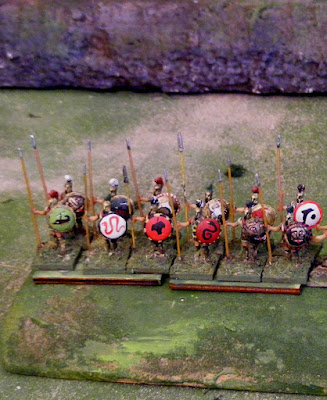
 The Athenians (Benassi) as seen from behind the Phrygian (Garrison) and Theban position. (The poor Thebans were left with the stragglers when I ran short on hoplites. At some point I need to finish refurbishing the last 48 RAFM hoplite types)
As I look at the table laid out for the refight, a puzzling question comes to mind:

Why didn't the Persians outflank and surround the Greeks?
The flanks don't appear to be resting on terrain, there are huge gaps in the middle of the line and lots of cavalry to ride around. The Thessalian cavalry seems to have given a deal of trouble to the Corinthinians and others marching up from the rear so were presumably ordered to ride past them but surely some of the cavalry could have been spared to attack the Athenians and/or Spartans from the rear?
Now I can see in the Dover refight that the lads were probably "in the spirit" and might not have considered such a move to be "on" but what about in the day? There are 3 possible answers that occur to me:
a) Heavily armed hoplites are dangerous to light troops and cavalry even if attacked in rear
b) There were command and control issues at work
c) Some of the Greek light armed troops who appear in the OB but not the battle narrative or the Grant scenario, were employed on rear security.
d) In the Grant scenario, Artabazos's troops start the game with the rest of the army rather than only coming up after the battle was essentially lost. That might substantially affect things.
Well, for the 1st run through, I am going to follow the battle plans in Grant's book as closely as possible so it shouldn't be an issue. I may try alternate versions later.

As I look at the table laid out for the refight, a puzzling question comes to mind:

The Pseudo-Spartans (mixed RAFM, Ral Partha, Garrison & Minifig)
from behind the (largely Garrison) Persian center.
from behind the (largely Garrison) Persian center.
Why didn't the Persians outflank and surround the Greeks?
The flanks don't appear to be resting on terrain, there are huge gaps in the middle of the line and lots of cavalry to ride around. The Thessalian cavalry seems to have given a deal of trouble to the Corinthinians and others marching up from the rear so were presumably ordered to ride past them but surely some of the cavalry could have been spared to attack the Athenians and/or Spartans from the rear?
Now I can see in the Dover refight that the lads were probably "in the spirit" and might not have considered such a move to be "on" but what about in the day? There are 3 possible answers that occur to me:
a) Heavily armed hoplites are dangerous to light troops and cavalry even if attacked in rear
b) There were command and control issues at work
c) Some of the Greek light armed troops who appear in the OB but not the battle narrative or the Grant scenario, were employed on rear security.
d) In the Grant scenario, Artabazos's troops start the game with the rest of the army rather than only coming up after the battle was essentially lost. That might substantially affect things.
Well, for the 1st run through, I am going to follow the battle plans in Grant's book as closely as possible so it shouldn't be an issue. I may try alternate versions later.
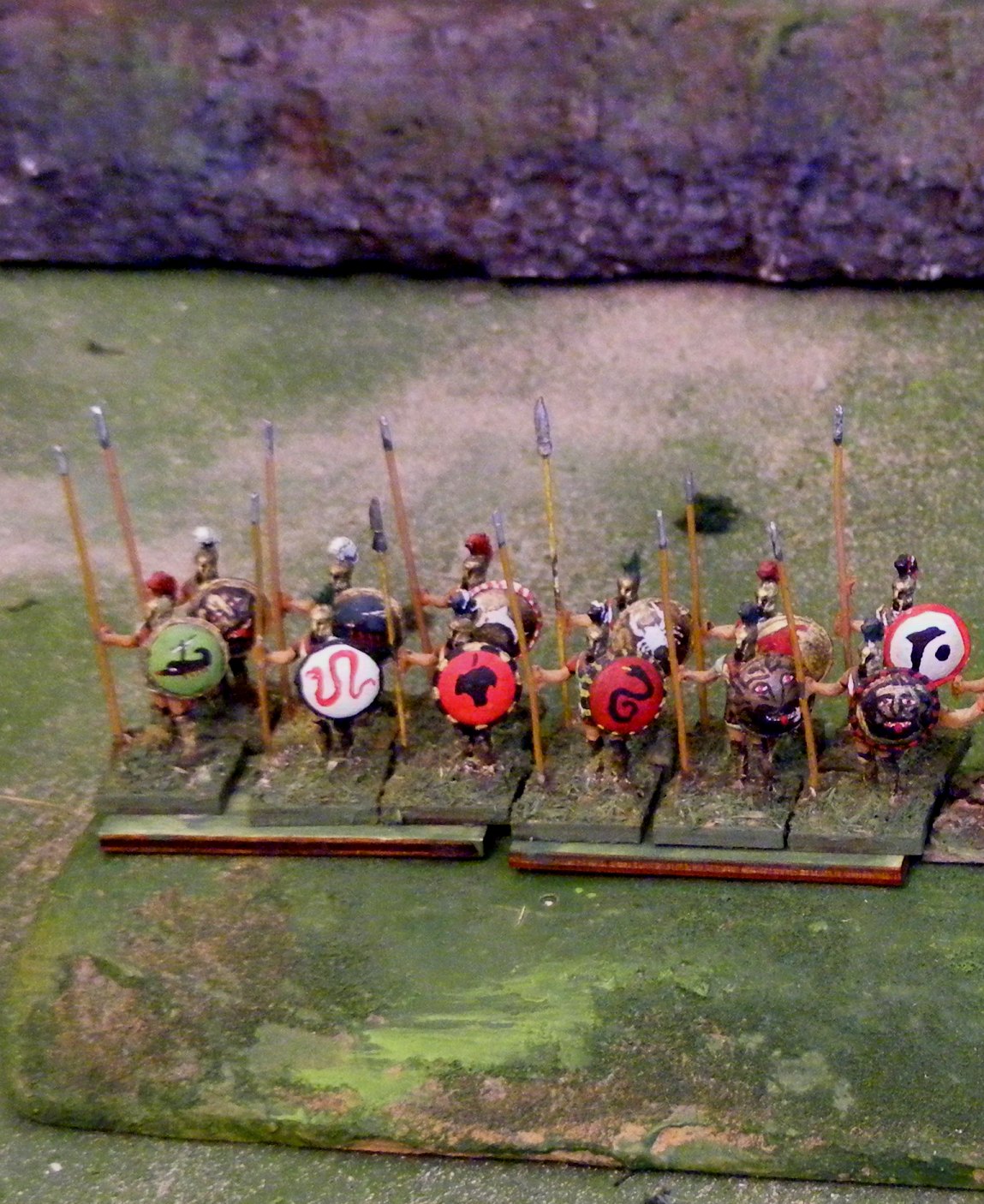
The Corinthians in position at the foot of the mountain, a lonnnng way from the action.
Rospak hoplites obviously painted while my 1st canine buddy, Yoda the Black Lab was still alive and providing inspiration.
Please click on the pictures to see the full thing if you are only catching the corner.
Friday, August 13, 2010
Preparing to play Platea using the new rules
Slings and Arrows of the outrageous fortune sort.
Turns out what I thought was a bit of a cold coming on, appears to be some sort of infection that the doctor suspects that I may have been incubating since my little hospital 'incident' 6 weeks ago. Anyway, now under the influence of antibiotics on top of everything else, I am slowly starting to function again but alas, no game this week A little planning has now resumed though.
_________________________________________________________________________________
The day after listing Platea on the poll as the potential historical battle, I decided to refresh my memory on the numbers involved, FORTY THOUSAND HOPLITES! . plus 10,000 more on the Persian side!
I don't have that many hoplites!
Even at 1 to 200 I don't have that many. Even if I had gotten around to getting one of those Garrison 100 hoplite deals that I had been adding and subtracting from that e-shopping cart and had then painted them up, I still wouldn't have enough to be convincing, although it would start to look better. Oh, and the Spartans got bumped from a previous order and still waiting so, not 1 Lambda in the lot. Luckily, before panic set in, I remmbered that the original idea hadn't been to refight Platea, it had been to replay Charles Grant's refight of Platea in The Ancient Wargame.
Technically, I still needed those extra 100 hoplites but since his 20mm Garrisons appear to be on the old 10mm wide frontage per hoplite and my troops are on a comfy 20mm wide base, one of my 24 man units should substitute nicely for one of his 42 or 50 strong units, especially on my smaller table. So a quick in-house vote was taken and me, myself and I voted unanimously in favour of using his order of battle but with my standard units sizes and classifications. As he remarks in his description of setting up the Sambre: "This is not an accurate conversion but the plain fact was that this was the total number of figures available, so what else could one do?" Indeed.
I did make a few changes to the details of troop types. Grant makes no mention of the WRG 3rd ed morale class used for the hoplites but does rate the Spartans and Heavy and the rest of the Greeks as Medium. Now normally, the Spartans are accepted as superior to other hoplites but the Athenians were at the top of their game. They were the only citystate to have met the Persians in battle and defeated them, indeed, there were probably veterans of Marathon in the ranks. The Spartans even tried to give them the place of honour vs the Immortals .So I figured they should rate the same. On the other hand, I'm not sure the Immortals were sufficiently better than the other contingents to warrant Elite status. Instead, I have invoked a shield barrier rule. Since the Persians were a hand picked force, I haven't rated any as "Levy".
The Persians also have several units of "light" infantry which under the WRG 3rd edition, would be the equivalent of my "Skirmisher" category. I would have called them "Medium" infantry myself but will compromise and field them as "Light" Infantry under my rules.
Last up, both sides are given 3 generals. That works fairly well for the Persians but is a bit of overkill for the Greeks who will end up with 1 general commanding a single unit of hoplites. After some debate, I decided to let it stand but ruled that each General only has authority and influence on his own units to reflect the allied and quarrelsome nature of the army.
Without further ado, here are the armies with their deployment based on the game described by Charles Grant in his book The Ancient Wargame. Each general will be assigned a card for activation. The unit names refer to the ones fielded in the book. The exact allocation of units on the Persian side is a bit vague but I have included the Phrygian spearmen in with the Thebans as the over all numbers of Medizing Greeks seemed low and it made sense to lump all the heavy units together.
The intent will be to play once with the battle plans as described in the book. I may, or may not follow that with a 2nd play through either basing the battle plans on Herodotus or going free form.
________________________________________________________________________________
GREEKS.
SPARTANS
Turns out what I thought was a bit of a cold coming on, appears to be some sort of infection that the doctor suspects that I may have been incubating since my little hospital 'incident' 6 weeks ago. Anyway, now under the influence of antibiotics on top of everything else, I am slowly starting to function again but alas, no game this week A little planning has now resumed though.
_________________________________________________________________________________
The day after listing Platea on the poll as the potential historical battle, I decided to refresh my memory on the numbers involved, FORTY THOUSAND HOPLITES! . plus 10,000 more on the Persian side!
I don't have that many hoplites!
Even at 1 to 200 I don't have that many. Even if I had gotten around to getting one of those Garrison 100 hoplite deals that I had been adding and subtracting from that e-shopping cart and had then painted them up, I still wouldn't have enough to be convincing, although it would start to look better. Oh, and the Spartans got bumped from a previous order and still waiting so, not 1 Lambda in the lot. Luckily, before panic set in, I remmbered that the original idea hadn't been to refight Platea, it had been to replay Charles Grant's refight of Platea in The Ancient Wargame.
Technically, I still needed those extra 100 hoplites but since his 20mm Garrisons appear to be on the old 10mm wide frontage per hoplite and my troops are on a comfy 20mm wide base, one of my 24 man units should substitute nicely for one of his 42 or 50 strong units, especially on my smaller table. So a quick in-house vote was taken and me, myself and I voted unanimously in favour of using his order of battle but with my standard units sizes and classifications. As he remarks in his description of setting up the Sambre: "This is not an accurate conversion but the plain fact was that this was the total number of figures available, so what else could one do?" Indeed.
I did make a few changes to the details of troop types. Grant makes no mention of the WRG 3rd ed morale class used for the hoplites but does rate the Spartans and Heavy and the rest of the Greeks as Medium. Now normally, the Spartans are accepted as superior to other hoplites but the Athenians were at the top of their game. They were the only citystate to have met the Persians in battle and defeated them, indeed, there were probably veterans of Marathon in the ranks. The Spartans even tried to give them the place of honour vs the Immortals .So I figured they should rate the same. On the other hand, I'm not sure the Immortals were sufficiently better than the other contingents to warrant Elite status. Instead, I have invoked a shield barrier rule. Since the Persians were a hand picked force, I haven't rated any as "Levy".
The Persians also have several units of "light" infantry which under the WRG 3rd edition, would be the equivalent of my "Skirmisher" category. I would have called them "Medium" infantry myself but will compromise and field them as "Light" Infantry under my rules.
Last up, both sides are given 3 generals. That works fairly well for the Persians but is a bit of overkill for the Greeks who will end up with 1 general commanding a single unit of hoplites. After some debate, I decided to let it stand but ruled that each General only has authority and influence on his own units to reflect the allied and quarrelsome nature of the army.
Without further ado, here are the armies with their deployment based on the game described by Charles Grant in his book The Ancient Wargame. Each general will be assigned a card for activation. The unit names refer to the ones fielded in the book. The exact allocation of units on the Persian side is a bit vague but I have included the Phrygian spearmen in with the Thebans as the over all numbers of Medizing Greeks seemed low and it made sense to lump all the heavy units together.
The intent will be to play once with the battle plans as described in the book. I may, or may not follow that with a 2nd play through either basing the battle plans on Herodotus or going free form.
________________________________________________________________________________
GREEKS.
SPARTANS
- Pausanius General for the Spartans and their allies only
- Alpha Battalion: 24 Elite Heavy Infantry on the right wing on Asopus Ridge
- Mesenian Javelinmen: 8 Levy skirmishers deployed behind the Alpha Battalion
- Beta battalion: 24 Elite Heavy Infantry in march column nearing the rear table edge
- Antelope Javelinmen: 8 Levy skirmishers with Beta battalion
ATHENIANS
- Aristeides General for the Athenians and their allies only
- Omicron Battalion: 24 Elite Heavy Infantry deployed on the left wing on Asopus Ridge
- Sigma Battalion: 24 Elite Heavy Infantry deployed on the left wing on Asopus Ridge
- Athenian Archers: 12 skirmishers with bow.deployed with hoplites.
THE REST OF THE GREEK ARMY
- A Corinthian General (Grant only provides player names for the sub-commanders on each side)
- Corinthian Battalion.24 Heavy Infantry deployed on 'the island' in the rear of the army.
_____________________________________________________________________________
PERSIANS
(all lined up along the Asopus River, ready to cross)
PERSIANS
- Mardonius Over all commander as well as left wing
- Green Immortals 24 Medium Infantry Archers with Spara
- Black Immoratals 24 Medium Infantry Archers with Spara
- Horsetail Light Cavalry: 12 Light Cavalry with bow
- Scorpion Cavalry with javelin
LEVIES
- Artabazos Sub General
- Median Javelinmen: 12 Light Infantry with javelin
- Crescent Light Cavalry: 12 Light Cavalry with bow & javelin
- Cadusii Light Infantry: 18 Light Infantry with spear and bow
- Apadan Light Infantry: 18 Light infantry with bow
MEDIZING GREEKS
- General over the Greeks (and Phrygians)
- Phrygians: 24 Heavy Infantry
- Boeotian Hoplites: 24 Heavy Infantry
- Theban Cavalry: 12 light cavalry with javelin
________________________________________________________________________________
With a little luck I should be able to play the 1st game on Wednesday and post a report a day or so later.
Subscribe to:
Posts (Atom)
