An Old Midlish Rhyme
The wind from the North sings of heroes of Olde
The wind from the East makes our blood run Cold
The wind from the South smells of Spices and Gold
But the wind from the West tells of warriors Bold.

Monday, August 20, 2012

Slik Road Battle

I know, I was going to post ancient battle reports here but this one is over there.


Somewhere over on the Silk Road, a long long time ago, a Persian Satrap clashes with the forces of Marakanda (Samarkand in later times).
 Persian Infantry and elephants
 Persian Cavalry
 Marakanda's horse archers backed by armoured lancers and camel riders.
 Marakanda's infantry, Greek militia, hillmen and native archers backed by an elephant to everyone's surprise. 
 The battle, mid-game

Friday, August 17, 2012

Squaring off

I've been pondering basing again. There are some good points to the 80mm wide bases and some attraction to the idea of 1 base = a unit, buutttt..... its also quite limiting. Of all the 25mm ancient basing systems I've experimented  with over the last 5 years, the one I like the best for itself as opposed to the game that it enables, is the one using 40mm square bases with 2 cavalry or 2,3 or 4 infantry per base. I do have some cavalry who will need to go a bit deeper, 60mm for the galloping Garrison horses, but I like the look and feel and its fairly flexible. For example, apart from adapting to multiple rule sets, you can do road columns which are not convincing when 80mm wide. The plan will be to do 4 base units as a standard organization


This happens to be 15mm standard for many rules which  won't help if playing some using standard 25mm  basing but that won't matter if both armies are mine. It does mean I can make impetus units out of 3 bases or if using 2 bases can match Ron's units for playing on a hex grid. I just tried it today using Comitatus and it worked great, well some units were on 40's from earlier experiments, others were singles on a 20mm frontage and I fudged the rest.  Getting ready for the game got my enthusiasm levels up high enough to finish 4 more Persian Clibinari and rebase them with the existing ones to finish that unit.

I also got a start at refurbishing my old Valdurian Royal Horse Guards to serve as Guards for the Queen of Marakanda.  I picked these Rohirrim lads up at the Minifig stand in the wargames tent at Aldershot the summer of 1974. My first metal cavalry. To keep up their status next to all those RAFM & Garrison horses I need to remount them, they've borrowed some PB horses here.

Anyone need 10 x S range 1/2 armoured horses?

First time in battle in decades and another victory to their credit.

Monday, August 13, 2012

Video footage of the battle of marathon

Amazing what you can find on utube some days.


Why is it that they look more like my old Rospaks than anything else?

Friday, August 3, 2012

Still Slowly Gathering


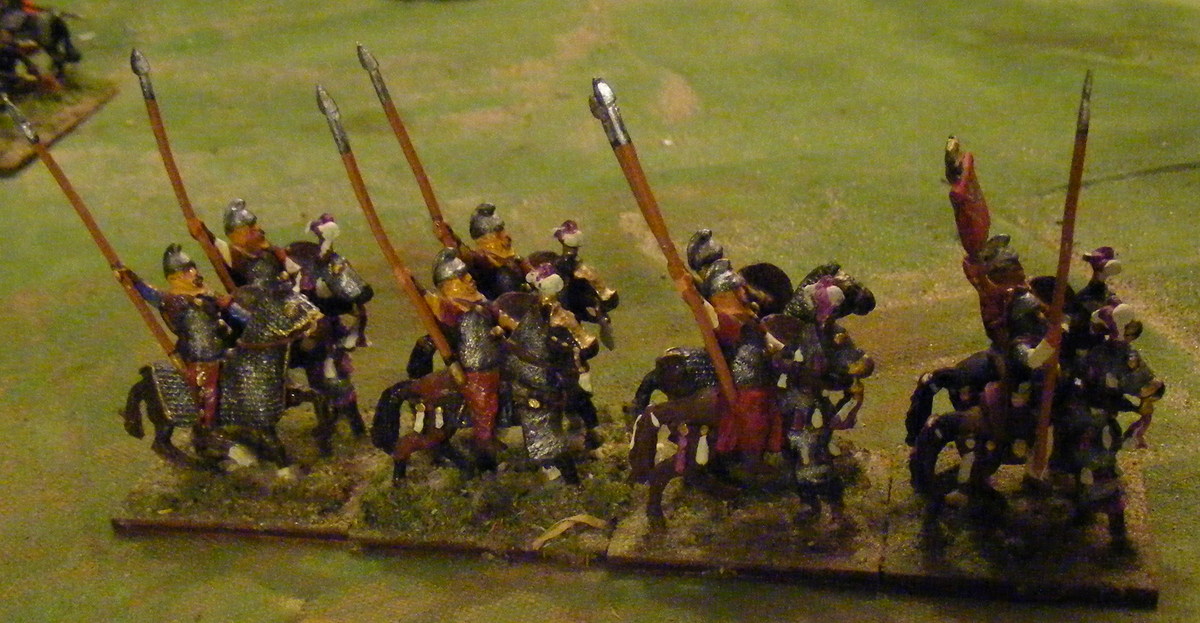
These lads were born as Garrison Sassinid Standard Bearers. They were destined to join my not really Sassanid Clibinari to give them some of that traditional bubble headed look.    Some how though, even with lances, they just didn't fit in with my other, lance and bow armed,  Clibinari and in any case I've been inching back from the Sassanid angle. If not lance and bow Clibinari on 1/2 armoured horses, then how should I arm them?

Prior to Alexander, Bactria and the surrounding areas seem to have produced bow and spear armed cavalry both unarmoured and armoured with some of the latter being on armoured horses. Alexander and presumably the Achaemenids before him, apparently also raised some Javelin cavalry from the southern areas reaching down into Afghanistan and two heavy javelins were standard Persian armament at the time. Some Greek cavalry would have still been javelin armed while others would have adopted the long Macedonian cavalry spear. Under the Seleucids heavily armoured Cataphracts were introduced and became the standard heavy cavalry of the Parthian Empire. In the turmoil between the fall of the Seleucids and the rise of the Kushan and Parthian empires, what would "native" cavalry raised in the area have been like?


Now its not a co-incidence that the current gathering of armies is set in a time and place where  information is limited, that was the goal from the beginning. My assumption is that cavalry would have been varied, especially in a time of dynastic struggles but that the later lance and bow on 1/2 armoured horse Clibinari are unlikely even though I plan to field some. Some cataphracts are more likely, especially those with felt and leather horse armour, as well as some other lancer cavalry but since the javelin seems to have persisted through out the period, that is also a likely option for some. Lightly armoured and unarmoured cavalry probably predominated but what percentage were "cavalry" vs "light cavalry" (a distinction that I'm not convinced was as clear at the time as it is in our wargames)?.


Another question is about the hats. It seems the latest fad is to dismiss what used to be the archetypal Sassanid Felt Bubble Cap as an error  but since there is evidence of some earlier Medes wearing a similar hat as well as later shepherds and the like, I am happy to assume that some thing similar has been worn by some people over the centuries. Possibly not in the area where this rebel Iranian heritage army is being raised to fight the last of the Greco-Bactrians but the hats give it a distinct flavour so they are in.

The figures just seemed to want to be modified into javelin armed cavalry so I obliged and ended up with javelin armed cavalry with shield and armour, possibly similar to Roman, later Greek or Celtic cavalry. I have been basing my shock cavalry 4 to a base and my horse archers 3 to a base and had planned to base these as four figures. The officer I painted to go with them just didn't fit so he has been relegated to command the next stand of lancers and these ended up 3 to a base.  This seems to put these in the well equipped light cavalry category so that's how I'll use them , leaving the real fighting to the heavily armoured lancers. .Mind you, I think these would serve well as early Mede cavalry as well. They need some friends though.

Friday, July 13, 2012

A Hex on Both Your Armies.

Wow, was that last post really 3 weeks ago?
King Daryros the Rebel, leads his men onto the field.

Anyway, I decided that i wanted to stay with the hexes for my ancients so reworded the rules. They can be used fairly easily without a grid by counting an "area" as 4" wide or such distance as pleases you, and measuring 60 degree arcs. I tightened things up a bit, swapped +/- die modifers for adding and subtracting dice per unit modifiers for combat. Can't do that when the number of dice is based on how many guys are in a unit but works well when its dice per unit. Also borrowed an idea and now allow units are allowed to swap up to 1 missile fire hit for a retreat if they wish.

The largely mercenary advance guard of the army of Alexandria the Farthest is led onto the field by Kinbg Antirossus himself.

 The first test game was small, an advance guard Teaser from Battlegames  but everything worked like a charm. A bigger one to follow when the heat in my games room abates.
King Antirossus , at the head of his Companions, puts the boots to King  Daryros's Rebels.